Email Marketing For Dog Businesses — The Complete Guide
The complete guide to email marketing for dog businesses. Learn how to build a list, write emails people actually want to read, and turn subscribers into loyal, paying clients.

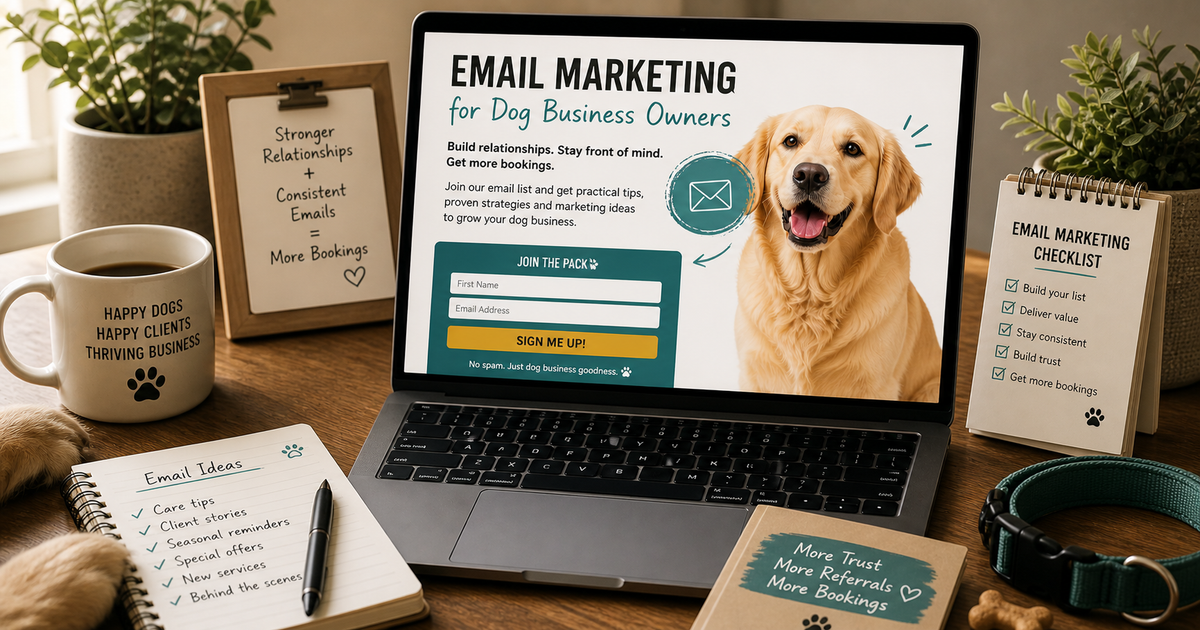
You're putting the work in every day, but still checking your phone at night wondering why the bookings or sales aren't where they should be for your dog business.
It's frustrating, isn't it?
You're posting on social media. Trying offers. Maybe even running ads.
And yet…
…It feels like you're starting from scratch every Monday.
You might be thinking, "I'm doing everything I'm supposed to… so why isn't it working?" Or, "I don't have time to learn another marketing tactic."
That’s fair.
Because right now, it probably feels like you're chasing attention that disappears the second you stop posting. One missed week, and you're invisible again.
That's exhausting.
You simply need something that sticks.
Email marketing does that, and for dog businesses specifically, it's one of the most underused advantages available.
It's consistently one of the highest ROI marketing channels available with industry figures suggesting a return of around £36–£40 for every £1 spent. It converts 2–5x better than social media, and unlike platforms that change the rules overnight, your list is yours forever.
No algorithms, just direct access to people who already trust you.
So if you want a simpler, steadier way to turn interest into bookings and sales, this guide will show you how.
Let’s dive in..
Why Email Marketing Works For Dog Businesses
Dog owners don't shop around forever.
They find someone they trust, and stick with them.
Think about your regulars. The ones who book like clockwork. The ones who say, "I wouldn't take him anywhere else." That kind of loyalty isn't typically built in a single visit. It's built in the gaps between appointments, bookings, and sales.
And that's where most dog businesses are lacking.
They have very little follow-up or communication to build a relationship with clients and customers.
So what happens?
Besides the odd few, your customer's life gets busy and they simply forget about you. And, more crucially, instead of coming straight back to you next time, they drift, see other deals and offers, leading them elsewhere. It’s not because they wanted to either, it’s because you weren't there when the moment came. You never stayed at the forefront of their minds and kept your business as the place to be.
Email fixes that.
It keeps you in their world between appointments, a quick tip, a short story, a simple reminder. Nothing fancy, just a consistent presence that reminds them you exist before someone else does.
It's part of the reason why businesses have email flows, and why some choose to drop them a message multiple times per week. Some even do this daily, like myself for the Pooch Profits newsletter.
It works.
And here's the part most dog business owners don’t realise.
You don't own your followers on social media. One algorithm tweak, and your reach disappears overnight. It's happened before and it will happen again.
But your email list? That's yours. No gatekeeper decides who sees you. You simply have a direct line to the people who already know your name, and chose to hear from you.
And it works across every type of dog business.
- Groomers
- Trainers
- Walkers
- Daycare operators
- Pet e-commerce brands
Different services, same principle, it doesn’t matter, you stay visible, trusted, and the bookings and sales follow suit.
So, now that you understand why email marketing is so important to your dog business, let's get to grips with how to do it.
How To Build An Email List As A Dog Business Owner
Before you can send a single email, you need people to send it to. The good news is you don't need thousands of subscribers to see results. A small, local, engaged list will outperform a huge disengaged one every time.
Here's how to build it from scratch.
Start With A Lead Magnet
A lead magnet is something that provides a benefit to your reader, and you use that in exchange for them giving you their email address and signing up to your email list.
You’re basically giving people a reason to hand over their email address. Again, the simplest way is to offer something genuinely useful in exchange.
A few examples that work well for dog businesses:
- 5 things your groomer wishes you knew before your dog's first appointment
- The puppy socialisation checklist, week by week
- How to stop your dog pulling on the lead, a 7-day plan
- A compendium style report
- Cheat sheet
- 10% discount on next order
It doesn't need to be complicated. Often, a one page of real specific advice beats a polished twenty-page PDF nobody reads.
Where To Collect Email Addresses
Once you have something to offer, you need places to collect signups. The obvious ones are often the most overlooked:
- Your website, a simple signup form above the fold
- After a booking confirmation, "Join our list for tips and offers"
- Your Google Business Profile, link to your signup page
- Your social media bio, one link, straight to your list
- Automatic signups from shopify stores (Klaviyo set ups, etc)
- A landing page dedicated to solving a problem your business fixes
What To Offer New Subscribers
Again, keep it simple, see the lead magnet advice above. The goal is immediate value, something they can use the same day they subscribe. The Pooch Profits free newsletter does exactly this, subscribers receive something useful the moment they sign up, before they've even opened a second email.
What to Send, Email Ideas for Dog Businesses
This is another area where most dog business owners get stuck. They set up the platform, import their contacts, and then stare at a blank screen wondering what on earth to actually say.
The answer is simpler than you think. You already have everything you need, your knowledge, your clients, your daily work. You just need a framework to turn it into emails.
Here are ten types that work consistently, rotate through them and you'll never run out of ideas.
- The tip email. One actionable piece of advice your clients can use immediately. What do you know that most dog owners don't? Start there.
- The story email. A real situation from your week. A tricky groom, a training breakthrough, a dog that surprised you. Stories build connections faster than any amount of promotion.
- The seasonal email. Fireworks anxiety in November. Summer heat and paw care. Christmas travel with dogs. These write themselves and your clients genuinely need them.
- The offer email. A promotion, a bundle, or a heads-up about limited availability. Keep these occasional so they land with weight when they arrive.
- The FAQ email. The question you get asked most often in person. Answer it properly in an email. If one client asks, fifty are wondering.
- The new service email. Announcing something new, but with context. Not just what it is, but why you added it and who it's for.
- The social proof email. Take one client's result or testimonial and tell the full story behind it. Specifics are everything here, vague praise convinces nobody.
- The re-engagement email. For clients who haven't booked in 60 days or more. A simple, warm check-in with a reason to come back. This one quietly recovers revenue most businesses don't realise they're losing.
- The referral email. Ask a happy client to recommend a friend. Most will if you ask directly. Almost none will if you don't.
- The behind the scenes email. A day in your life, your setup, how you work, what goes into what you do. Clients who feel like they know your world stay loyal far longer than those who don't.
Pick one and write it today.
A few More Ways To Find Subscribers For Your Dog Business Email List
If you’re only relying on one way to grow your list, it's going to feel slow.
And when it feels slow, it’s easy to stop.
So let’s fix that.
Turn Your Content Into Subscribers
If you’re already posting on social media, don’t just post and hope.
Give people a next step.
Write a useful blog post. Something specific. Something searchable. Something a dog owner actually wants.
Then share it on your social channels.
At the end of that post?
Link to your signup page.
Example:
A groomer writes “How to stop your dog’s coat matting between appointments”.
Share it on Facebook.
Dog owners click, read, get value, and see a simple “Want more tips like this? Join here.”
That’s how casual readers turn into subscribers.
You can also post every email you write on social media, and again, the same CTA to go here if you have would like more tips like this sent to your email (don’t forget to mention the free lead magnet too.)
Use Paid Ads (but understand this first)
Paid ads can grow your list fast.
But the game has changed.
Since the Andromeda update, Meta isn’t relying on your targeting the way it used to. It’s leaning heavily on your creatives. Basically, your hook and angle.
Which means…
A weak ad won’t just underperform. It’ll burn money.
If you’re running ads to a lead magnet, you need:
A strong hook, clear promise, and a simple path to sign up.
Something like:
“Dog owners: stop your dog pulling on the lead in 7 days (free plan)”
And you’ll also need multiple creatives for the one ad.
If you’re not confident on the creative side, this is where most campaigns fall apart. It’s also where a proper strategy makes all the difference. That’s why I offer a creative strategist service for dog businesses.
You don’t need dozens of tactics.
Just a few that you do consistently.
That’s how your email list will grow in the dog business world.
How Often Should a Dog Business Send Emails
More than you're currently sending.
That's the honest answer.
Most dog businesses hold back because they don't want to annoy people. Fair enough. Nobody wants to be that inbox pest, but here's the counterintuitive bit.
As alluded to earlier, silence is what costs you clients and sales. If someone hasn't heard from you in weeks, you're not being polite, you're being a stranger.
Weekly is the bare minimum, it keeps you in the picture. Two to three times per week is where things start to click. Not because you're pushing harder, but because you're showing up more often with useful, relevant, easy-to-read emails.
Think of it like this.
One long email every few weeks is like bumping into someone once a month and trying to pick up where you left off. Short, consistent emails are a quick chat every few days.
That's how relationships are built.
Consistency beats length. Frequency beats perfection.
And yes, daily emails can work when done right.
Email Platforms for Dog Businesses
Don't overcomplicate this.
You don't need the perfect platform, you need one you'll actually use.
Mailchimp. A solid starting point. Free for small lists and easy to get going.
Klaviyo. Ideal if you sell physical products and use Shopify, WooCommerce, or want proper email flow automation. Think rebooking reminders, abandoned cart follow-ups, Welcome messages, and post-appointment sequences that run without you.
Kit (formerly ConvertKit). Clean and simple, built for service businesses. A good balance of ease and control and regarded by many as a great option.
Ghost Pro. A different approach entirely. Website and newsletter in one place. Worth considering if you want to write regularly and build an audience around your content.
Here’s three questions worth asking before you choose:
- Can you send emails easily?
- Can you automate key sequences?
- Can you grow your list without friction?
If the answer is yes, you're good to go
Email Automation, The Sequences Every Dog Business Needs
Automation isn't about being robotic.
It's about being there, even when you're busy. Set email flows up once and they keep working in the background while you get on with the job.
Here’s a bit more information on a few flows:
The Welcome Sequence
This is your first impression, and it matters more than any email you'll ever send one-off.
Someone joins your list; they're curious, interested, paying attention, but that window doesn't stay open long. That’s why a simple 3 to 5 email sequence works best. You introduce yourself, deliver what you promised, share something useful, then make a gentle offer by nurturing them..
A basic example for a dog groomer might look like this:
- Day one, deliver the lead magnet and a brief welcome message
- Day two, a quick tip they can use immediately.
- Day three, a client story they'll relate to, and a soft CTA
- Day four, a soft invitation to book your services
No pressure, just guidance.
If done right, this sequence converts really well. Your welcome flow will be different depending on the type of dog business you're in. For example, if you sell physical products, it will still be sent out like above, but the content will be more tailored towards getting another sale.
For example:
- Day one, deliver the message welcoming them and provide a 10% discount of next product/ or an upsell
- Day two, a quick tip they can use immediately.
- Day three, a client story they'll relate to, and a reminder about the discount you gave them
- Day four, a soft invitation to view new products
Again, it’s all about the content, and being written carefully to nudge them along.
The Rebooking Sequence
This one quietly recovers lost revenue most dog businesses don't even realise they're losing.
Not every client who goes quiet is gone for good, most just forgot.
Set a trigger, six weeks, eight weeks, whatever fits your service. Then send three simple emails. A reminder of what they're due, a reason why leaving it too long causes problems, and a nudge with an easy booking link.
No hard sell here, just prompts that bring people back.
The Post-Appointment Sequence
The job isn't finished when the appointment ends. In many ways it's just started.
Follow up while the experience is fresh. Send aftercare advice and reinforce the result. Make them feel looked after. Then ask for two things, a review and a referral. Most happy clients are willing when you strike early. They just need you to ask.
One simple email, sent at the right moment, can turn a single booking into three.
There are plenty more email flows worth exploring, but the above is an example of what you can do with email marketing, especially in the dog niche.
Let’s move on to the mistakes you can make.
Common Email Marketing Mistakes Dog Businesses Make
Most mistakes aren't complicated, they're small issues, repeated over time.
For example:
- Only emailing when there's something to sell
- Writing long, stiff, overly formal emails
- Disappearing for weeks then popping back up out of nowhere
- Using generic templates that feel cold and forgettable
- Never asking for reviews or referrals.
- Letting the list go quiet, then sending the classic "sorry I've been quiet" email
- Selling unrelated items
The trick is to treat your list like you would a friend. By that I mean, not sending them trashy content, or spamming them. If you wouldn't feel comfortable sending the email to a friend, don’t send it to your list.
Frequently Asked Questions
Let’s wrap up with a few FAQs related to email marketing in the dog business world:
Does email marketing work for small dog businesses?
Yes, and often better than you'd expect. A list of 50 local dog owners who hear from you regularly will outperform a list of 1,000 who don't. It's not about size. It's about familiarity. If they recognise your name, trust builds and bookings follow.
How do I get my first email subscribers?
Start with the people who already trust you. Ask at the end of an appointment, keep it simple. "Want tips and updates by email?" Most will say yes. Then make it easy with a signup form on your website and a link in your social bio. One clear path, no friction.
What should my first email say?
Keep it straightforward. Thank them, deliver what you promised, and tell them what to expect. Then ask one question, something like "what's the biggest challenge you're having with your dog right now?" Replies matter more than opens. That's where the relationship starts.
Should I use my personal email or a business email to send?
Always a business email — something like hello@yourbusiness.com. Sending from Gmail or Hotmail damages deliverability and looks unprofessional. Most hosting providers include a business email address for free.
How long should emails be?
Short. 150 to 400 words is a good guide. One idea, one message, one outcome. If they can read it in under two minutes, you're on the right track.
Can I use email marketing if I only have a small local area?
Absolutely. Local is actually an advantage with email. A list of dog owners in your town who hear from you weekly builds the kind of familiarity that drives referrals, rebookings, and word of mouth faster than any national campaign ever could.
Is Klaviyo good for dog businesses?
It is, when used properly. Particularly for product-based businesses or those wanting automation, rebooking reminders, win-back emails, post-appointment follow-ups. Set it up once and it runs quietly in the background. That's where the real value is. Just be cautious with their pre-built flow templates — they tend to be generic and worth rewriting in your own voice.
One Last Thing Dog Business Owners
Email is the one channel that keeps working while you're hands-on. While you're grooming, walking, training, stocking up products, simply running the everyday business, email keeps doing its thing.
It doesn't stop when you do.
Build it once, show up consistently, and over time it compounds.
If you want a faster way to get there, the Pooch Profits daily newsletter shares practical email and marketing ideas for dog businesses every day, for free.


