META ADS For Dog Business Owners (+ Andromeda Tips & Examples)
Based on hours of research, experience, and analysis; here's how dog business owners can confidently create META ads post Andromeda update.
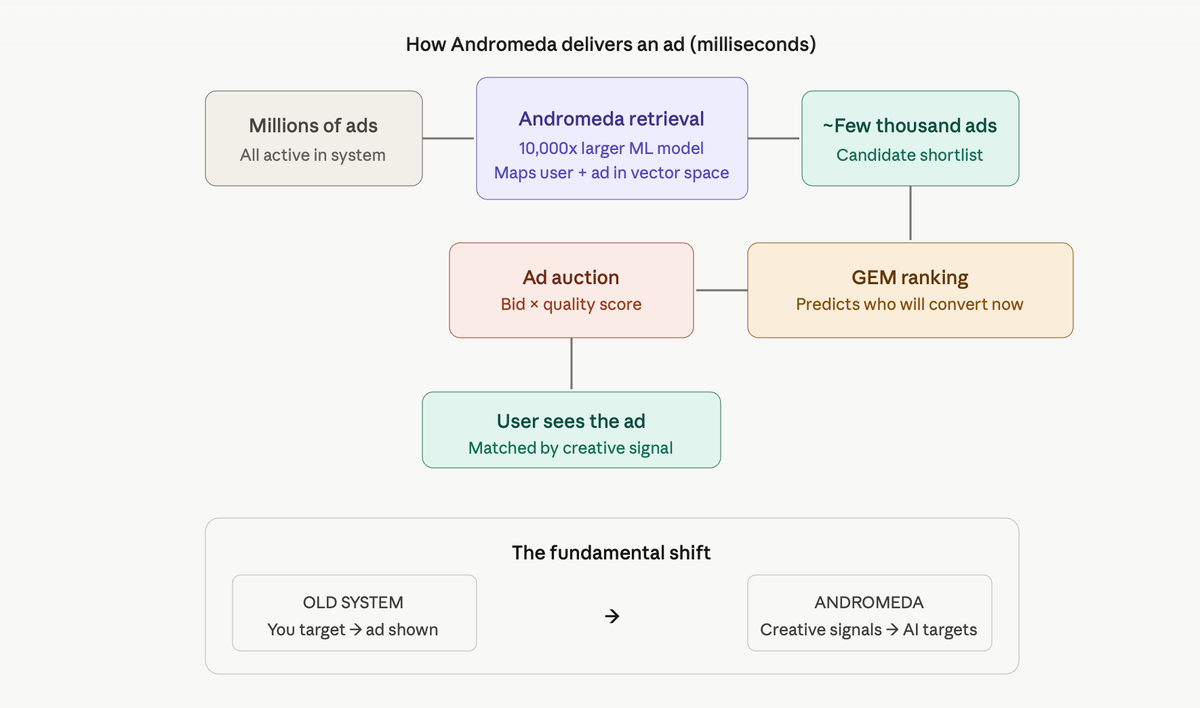
If you're a dog business owner and you want to create META ads with the best possible strategy for success, post Andromeda, you'll need to do things a bit differently because the algorithm has changed.
And what worked in the past no longer gets the same results.
Maybe you've noticed this yourself with higher CPC (cost-per-click) and CPL (Cost-per-lead), or heard whispers amongst the corridors of online forums and social media hook catchers. Perhaps you're going to give META ads a shot for the first time, and you don't want to burn money like many businesses are today, without a solid strategy for 2026 and beyond.
You could even be in the one-chance brigade, where your first campaign needs to be a success; otherwise, it could be a while till you have the funds for another try.
Either way, this guide will share with you the knowledge from my in-depth research, testing, and hours of fact-checking.
I truly believe (without a guarantee, of course) that this will give you the best chance of being a success with paid META ads post Andromeda.
Let's get started.
What is the Meta Andromeda Update? (And What Dog Businesses Must Understand)
Andromeda was announced in December 2024, and launched in October 2025.
The background story involves META's failure of their business plan to launch Metaverse around 2021 — basically a virtual 3d world where people could shop online with the experience of being inside the stores. The plan was to incorporate socialising, avatars, and a virtual world.
Mr Zuckerberg and the his merry men (and woman) threw a heck of a lot of money at the project which involved billions of data points, virtual chips, and a new company rebrand called, yes, you guessed it, META.
However, to make a long story short, the plan went wrong, the losses heavy, and they basically accepted defeat around 2022/23.
The public didn't want Metaverse.
Now Mr Zuckerberg (and his team) being savvy business people decided to push all these data points and super chips towards their advert algorithm for the following reasons:
- The old system was starting to crack due to the AI creative stampede. Meta's Advantage+ tools and third-party AI tools flooded the ad system with millions of new creative variations (almost overnight) The old system technology couldn't process them fast enough and the retrieval became the bottleneck. Advertisers were losing impressions not because of bad bids, but rather because the system couldn't keep up.
- Privacy updates, GDPR, browser privacy rules changes had all caused an issue for the old signals which effectively starting to damage the old targeting model.
- User experience was deteriorating and threatening Meta's business. When low-quality, repetitive, or irrelevant (AI generated) ads started to dominate the feed, users began to lose interest in the platform. As Meta's revenue depends entirely on people using the platform they had to make a change.
- Dog business advertisers (and every other industry) ROI was declining and Meta needed to defend its platform. Smaller advertisers were quitting the platform and migrating to TikTok — they needed to act.
- Meta needed to change the system to scale to its own ambitions. With Threads, Reels, and further Advantage+ automation all expanding the ad space, Meta required infrastructure that could handle tens of millions of active ad creatives across multiple platforms at the same time. Well, to be precise, in under 300 milliseconds per impression. The old rule-based retrieval layer wasn't built for that scale. Andromeda, running on custom MTIA chips and NVIDIA Grace Hopper Superchips, was.
Four Things Dog Businesses Must Get Right With Meta Ads Post Andromeda
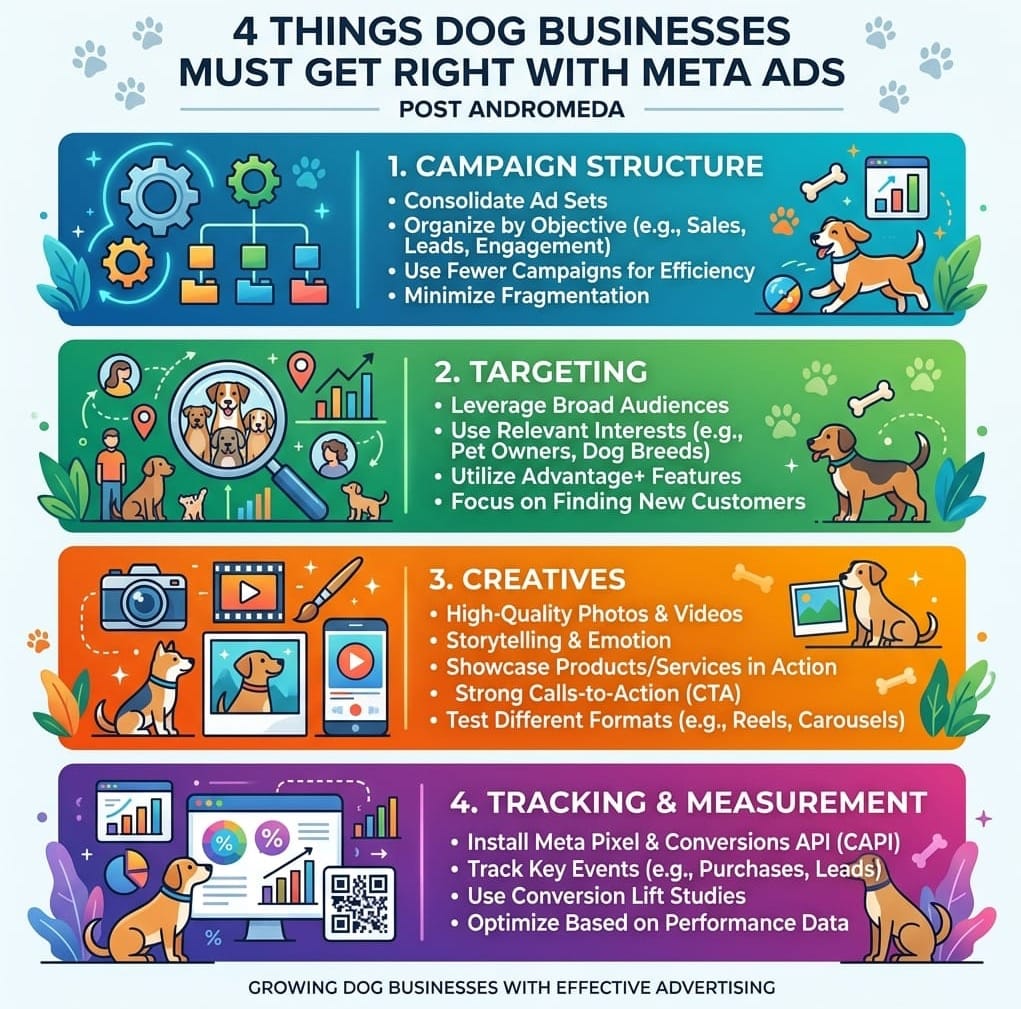
When business are overpaying by 20-60% for their ads since the update, things start to become more urgent, and to overcome this, or to stop this happening to you; pay attention to the four following aspects of a META ad campaign.
1. Campaign structure (simplify)
The new simplified structure performs best initially during testing, when using two ad sets per campaign and, depending on budget, placing 5-10 unique creatives in each ad set.
Why?
Because this gives the new algorithm the best basis for choosing ads that readers will react to, and keeps things simpler for everyone. One campaign set up, with ad sets targeting warm and cold traffic is the recommended strategy, with broad being cold traffic, and warm being retargeting.
2. Targeting — go broad and trust the algorithm
Meta now officially recommends that advertisers adopt broad targeting. Use Advantage+ placements, and allow the algorithm to make its own delivery optimisations.
Campaigns using broad targeting (no interest filters, age 18–65+, all genders) allow Meta's algorithm maximum exploration space to discover high-converting user segments that manual targeting would miss.
This is recommended because META knows everything about you, your friends, family, and your audience. They know what you like to eat, your favourite sports teams, your hates, frustrations, colour of your hair, and even your voice.
Just understand that they know all this, and targeting is no longer that important.
Exception for new accounts: If you're starting from scratch, Andromeda does still need a little direction. You might start with some light targeting guardrails, then remove them once Meta has enough conversion data.
3. Creatives — this is where you win or lose
In the Andromeda era, creatives (the images and videos) act as the primary signal for targeting. To succeed, you need a broad library of assets that speak to different angles and stages of the customer awareness.
Very Important: Minor creative tweaks are no longer viable. Andromeda groups similar ads together. Changing a headline colour, swapping a CTA, or trimming two seconds from a video usually results in the same ad being treated as a duplicate.
Creating videos such as B-roll, UGC, Talking Heads, and Static ads is the way to go. Formatting them for different sizes will still count as the same ad.
What actual diversity looks like:
- Free shipping vs bundle discount
- Before/after vs unboxing
- UGC vs animated vs founder-led
- Different hooks and angles
How many creatives do you need?
This kind of depends on your budget, but Meta now recommends 8–15 creative variations per ad set as a minimum for optimal Andromeda performance.
The trick is to kill the ads that have no or little traction, and keep testing new creatives. Eventually, you’ll have 50 ads per campaign, depending on your budget, of course.
Here's what a good hook actually looks like for a dog business:
Most dog business ads open with something like "At [Business Name] we offer professional dog therapy care across [Location]." Many feel this is good, but in reality, that's a business introduction, not a hook.
Nobody stops scrolling for that.
A hook that works opens with something the dog owner is already thinking or feeling. Something that keeps them awake at night such as:
"Your dog has been anxious for months. You've tried everything. Here's what changed instantly after one session."
Or for a harder sell angle: "Most dogs that come to us have been turned away somewhere else. Here's why that doesn't worry us."
The first three seconds need to make the viewer feel seen, curious, or slightly unsettled. If it could apply to any business in any industry, it isn't a hook.
And finally, one last thing regarding the creatives to be aware of is the dip in performance. Even top-performing ads can drop off after 2–4 weeks, so always be checking the performance, which leads to the next section.
4. Tracking and data signals — non-negotiable
This is the foundation on which everything else sits. If your data is broken, Andromeda is learning from lies.
Pixel-only tracking is no longer sufficient, mainly due to browser blockers. The Conversions API (CAPI) sends server-side events that survive browser privacy restrictions.
Run both with deduplication enabled. Meta reports that advertisers with CAPI active for web events see an average cost per result that is 17.8% lower than those using only the Pixel.
The Event Match Quality (EMQ) score is your tracking health indicator. A score below 7 means Meta is having trouble matching your conversion events to real users, which degrades Andromeda's learning.
How to Find this in Events Manager?
Good news: As of April 2026, Meta released a one-click CAPI setup directly from Events Manager, so no proprietary servers, no additional costs, no ongoing maintenance.
Meta hosts the infrastructure, and you start sending server-side data in minutes.
Meta Ads Metrics That Matter Post Andromeda — And The Ones To Stop Chasing

If you're still optimising your campaigns based on CTR and CPM alone, you're flying blind post-Andromeda.
The algorithm has shifted what matters, and chasing the wrong numbers will cost you money.
Here are the metrics that now tell the real story.
Cost Per Result (by conversion event)
Forget vanity metrics. The only number that matters at the campaign level is your cost per result, and that result must be tied to a meaningful conversion event. For example, for a dog therapy business, that means a booking, an enquiry form submission, or at a minimum, a landing page view. If you're optimising for link clicks, you're teaching Andromeda to find clickers rather than buyers.
Thumb-Stop Rate (TSR)
The percentage of people who stop scrolling when your ad appears. It's calculated as 3-second video views divided by impressions, multiplied by 100. A TSR above 30% is considered strong. Below 20% and your hook is failing — which means Andromeda will deprioritise delivery before most people even see your offer. Monitor this weekly. If it's low, the problem is almost always the first three seconds of your video.
Hook-to-Hold Rate
Where TSR tells you if people stopped, Hook-to-Hold tells you if they stayed. This is the percentage of people who watched your video to the 25% mark after watching the first 3 seconds. A strong Hook-to-Hold rate (aim for 40%+) means your hook delivered on its promise. A low rate means people stopped briefly, decided you weren't worth their time, and kept scrolling. This is your creative quality signal.
Frequency
With Andromeda, frequency becomes important faster than most advertisers expect. When the same person sees your ad more than 3–4 times without converting, you're not just wasting budget; you're also damaging your brand positioning and training the algorithm to think your ad isn't resonating with your audience. Watch out for the frequency at the ad set level. When it goes above 3.5, switch it for a new creative immediately.
Event Match Quality (EMQ) Score
I’ve already mentioned this in the tracking section, but it belongs here as well because it affects every other metric you're reading. Your EMQ score (found in Events Manager) tells you how well Meta can match your conversion events to real user profiles. A score below 7 means Andromeda is making delivery decisions based on incomplete data, which means every metric you're looking at is distorted. Get this above 7 before drawing any conclusions from your results.
Cost Per Lead vs Cost Per Acquisition
These are two different things, and conflating them is an expensive mistake. Your CPL is what you pay per enquiry or form fill. Your CPA is what you pay for an actual paying client. For a dog therapy business, the gap between the two is where your sales process either saves you or sinks you. Track both. If your CPL looks fine but your CPA is sky-high, the ad isn't the problem — your follow-up is, and this could be down to poor marketing, and likely no email flows or poor copy.
Return on Ad Spend (ROAS)
ROAS is still a useful north star metric, but post-Andromeda, it requires patience. During the learning phase, ROAS will look terrible. Many advertisers panic, kill campaigns early, and restart, which resets the learning phase and makes things worse. Give new campaigns 7–14 days and 50 conversion events before making any judgments about ROAS.
What Will Destroy Your AD Performance
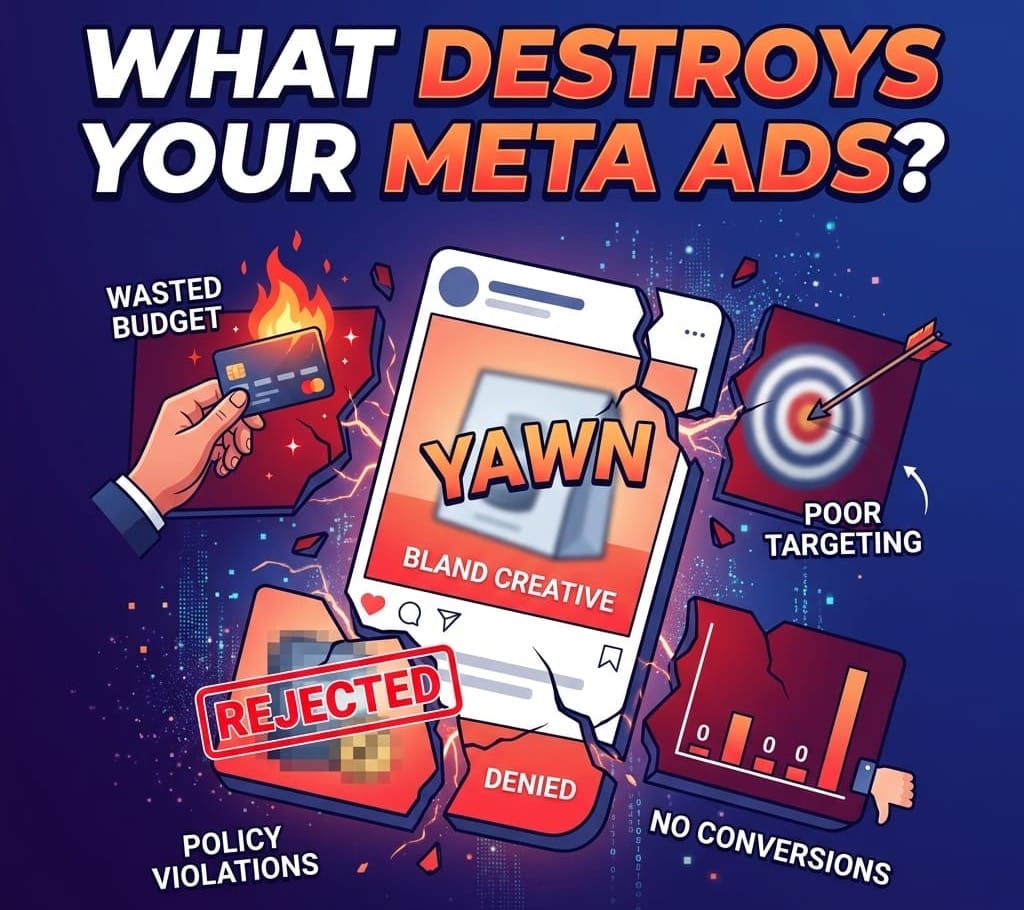
Knowing what to do is only half the equation. Andromeda has created a new set of failure modes that weren't as punishing under the old system.
Here's what to avoid.
Editing campaigns during the learning phase
This is the single most common mistake, and it's a silent campaign killer. Every time you make a significant change to a live campaign — adjusting the budget by more than 20%, changing the audience, swapping the conversion event, or editing the creative — Meta resets the learning phase.
You are essentially starting from scratch.
Post-Andromeda, the learning phase wants 50+ conversion events per ad set per week. If your budget doesn't support that volume, consolidate. Do not spread a small budget across multiple campaigns and expect results.
Creating too many similar ads
I've touched on this but it's worth saying again. META now groups similar ads and treats them as one advert. If you take one video and change the images, this isn’t another ad.
This will waste your budget.
Genuine creativity means completely different angles and hooks.
Ignoring poor performance (even from good starters)
Even your best-performing ads will eventually start to deliver poor results. Post-Andromeda, top creatives typically (not always) peak within 2–4 weeks before performance drops off.
Most advertisers notice this and panic, cutting budgets or restructuring campaigns, when the real fix is simply refreshing the creative.
The advertisers who win in the long term are the ones who continue to write and create new creatives on a regular basis.
Using the wrong conversion event for your budget
This is a budget calibration problem that destroys more campaigns than most people realise.
If you're spending £15/day and optimising for bookings, and bookings cost you £40 each, the maths simply doesn't work — Meta can't gather enough conversion data to learn.
Drop down the funnel. Optimise for Landing Page Views or View Content first, build conversion volume, then shift the event once the data is there.
Trying to skip straight to the bottom of the funnel on a thin budget is one of the most reliable ways to burn money with nothing to show for it.
Turning campaigns off and on
Switching off a campaign, even for a day or two, can disrupt the platform's delivery process. When you turn it back on, META will treat this as a new campaign and re-enter the learning period again.
If you do this for budget reasons, maybe reduce daily spending rather than pausing.
Over-segmenting your audience
The old playbook of tightly defined interest stacking — dog owners aged 28–45, within 10 miles, who follow dog training pages is now actively counterproductive.
You're restricting the algorithm's exploration space and raising your costs. Broad targeting with strong creative is the new precision targeting. Let Andromeda find your audience.
Your job is to give it enough creative variety to work with.
Misreading the post-iOS 14 attribution window
Meta's default is a 7-day click, 1-day view window. This means conversions that happen up to seven days after a click are matched to your ad.
Many businesses check their ad performance within a day or two and see no conversions, and assume it isn't working.
You need to realise that Andromeda needs time. Set your reporting window correctly, be patient through the learning phase, and don't make reactive decisions based on 24-hour data.
Going Deeper On Understanding The Learning Phase (And Why It Changes Everything)
Before we get to the budget section there's something you need to understand properly, because it sits underneath almost everything else in this guide.
As mentioned briefly, when you launch a new campaign, ad set, or make a significant change to one that's already running, Meta enters a period where it's actively working out who to show your ad to, when to show it, and what it should cost.
This is also part of the learning phase. During it, performance will often look rough. Costs will be higher. Results will be all over the place.
And again, as alluded to earlier, the temptation to step in and start making changes is hard to ignore. Please don't do this.
With Andromeda, the learning phase is more demanding than it used to be and ideally it needs 50 conversion events per ad set per week before it can exit learning and start delivering properly optimised results.
That's not 50 clicks. It's 50 of whatever conversion event you've told Meta to go after. If you're optimising for bookings and you're only getting 6 a week, you'll be stuck in the learning phase indefinitely, paying over the odds for inconsistent delivery.
What this means for a dog therapy business in practice:
If your budget is tight, optimise for Landing Page Views or View Content first.
These occur more often, which means Meta reaches 50 events faster, exits the learning phase sooner, and starts delivering at a lower cost.
Once the campaign has momentum and data behind it, you can push the conversion event down toward the action you actually want.
Think of it like warming up before a run.
Skipping it doesn't save you time.
How long does the learning phase last?
Again, 7 to 14 days, as long as your budget generates enough conversion events. A quick way to check is to divide your weekly budget by your estimated cost per conversion event. If the number comes back below 50, your budget may need to go up, your conversion event needs to change, or both.
And remember, the learning phase also resets if you change your budget by more than 20% in one go, edit your audience, swap your conversion event or pause and restart the campaign.
Every reset means starting over so set it up correctly the first time.
This is why leaving things alone in the first two weeks matters more than most people think.
Budget Reality Check (Know This Before You Spend A Penny)

Most guides skip this part, but this won't because if you're working with a limited budget and need this to work the first time, you need to go in with clear expectations.
Meta advertising post-Andromeda has a minimum viable budget. Below it, the algorithm can't learn fast enough to deliver results, and you'll burn through your money before generating the data needed to improve anything.
For a service-based dog business in the UK, you're looking at £25-£40 per day per ad set to give Andromeda something to work with.
Spend less than that, and you'll struggle to exit the learning phase before the budget runs out. On £25 a day across two ad sets, you're spending £350 a week. For Andromeda to learn properly, that spend needs to generate 50 conversion events per ad set. If your estimated cost per landing page view is around £0.80, you're generating well over that. But if you're going straight for bookings at £35 each, you'd be lucky to get 10 a week.
That's 40 short of what the system needs.
This is why conversion event selection isn't a minor technical detail. It's a budget decision.
A simple framework for dog businesses on a low budget
Under £20 a day: skip conversion campaigns for now. Put the budget toward awareness and engagement. Build up your pixel data, grow your warm audience, and come back to this when the budget allows.
£20-£40 a day. Simply run one campaign with one cold ad set. Optimise for Landing Page Views or ViewContent.
Don't attempt to optimise for bookings yet.
£40 to £80 a day: run the two ad set structure, cold and warm, and optimise for a mid-funnel event. Start testing bottom-funnel optimisation once you've got conversion volume behind you.
£80 a day and above: you've got enough to run the full structure in this guide, test creative properly, and optimise directly for bookings or enquiry submissions.
One note on geography: if you're based in a rural area or a smaller town, your audience pool is smaller by default, and broad targeting works less well in those conditions. A loose radius restriction of around 15 to 20 miles is a sensible guardrail in that situation. Not for interest stacking, just location. Don't be afraid to use it.
The Bottom Line On META ADS Post Andromeda For Dog Business Owners.

The Andromeda update has been seen by many businesses as making Meta advertising harder. This isn't entirely true; the truth is that it has made bad Meta advertising more expensive.
It's also helped to clean up the sheer amount of AI trash on the platform.
The businesses overpaying by 20 to 60% right now aren't being unlucky. They're running fragmented campaigns, making changes during the learning phase, recycling the same creative in slightly different formats, and feeding messy tracking data to an algorithm that's trying to help them.
The core of what makes advertising work hasn't changed. You still need to get in front of the right people with a message that makes them stop, feel an emotion, and ultimately take an action.
However, what has changed is how you create the conditions for that to happen.
Andromeda rewards advertisers who keep their structure simple, give the platform room to test with broad targeting, invest in genuinely different creatives, and feed the platform fresh data.
Those four things build on each other over time.
A well-built campaign left to learn will outperform a constantly adjusted one within weeks.
For most dog businesses specifically, the opportunity is real. Advertiser competition in this space is still relatively low compared to other industries, which means your cost per lead and cost per click can be very competitive when your creative is strong and your tracking is clean.
The businesses that win here won't necessarily have the biggest budgets. They'll be the ones who understand how the system works and stop fighting it.
Set it up right. Give it time, and keep producing new creatives.
Dog Business Andromeda FAQs
Below is a selection of questions and answers related to METAs Andromeda update and specific to those running a dog related business.
How much should a dog business spend on Meta ads in 2026?
There's no universal answer, but there is a floor. For a service-based dog business in the UK, you need a minimum of around £25 to £40 per day per ad set to give the algorithm enough data to learn from. Below that, you'll likely burn through your budget before Meta has gathered enough information to optimise delivery. If you're working with less than £20 a day, hold off on conversion campaigns and focus on building your warm audience through engagement and awareness first. Come back to paid conversion campaigns when the budget is there.
What is the Meta Andromeda update, and how does it affect dog businesses?
Andromeda is Meta's new updated ad delivery system, launched in October 2025. It replaced the old rule-based targeting system with a far more powerful AI-driven model built on the same infrastructure Meta originally developed for the Metaverse project. For dog businesses, the practical impact is this: creative quality now matters more than targeting exactness. The algorithm finds your audience based on how people respond to your ads, not the interest filters you set. Strong creatives get rewarded with cheaper delivery. Weak creative gets penalised quickly.
Why are my Meta ads not working after the Andromeda update?
The most common reasons are a campaign structure that's too fragmented, creative that isn't genuinely diverse enough, tracking that runs only on Pixel without the Conversions API, or changes made during the learning phase before the algorithm has had time to optimise. Any one of these can quietly drain your budget. If your Event Match Quality score in Events Manager is below 7, start there — everything else you're reading in your reporting will be distorted until that's fixed.
How many ads should a dog business run on Meta?
Meta recommends 8 to 15 genuinely different creative variations per ad set for best performance under Andromeda. The keyword is genuinely different. Resizing the same video or swapping a colour doesn't count as a new ad; the system groups similar creatives together and treats them as one. Different means different hooks, different formats, different angles. Start with 5 to 8 if the budget is tight, cut the ones with no traction quickly, and keep testing new ones. Over time, you'll build a library of proven performers.
How long does it take for Meta ads to work for a dog business?
Give any new campaign at least 7 to 14 days before drawing conclusions. This is the learning phase, during which costs will be higher, and results will be inconsistent. That's normal. The mistake most business owners make is checking results after 48 hours, seeing nothing, and either changing the campaign or killing it entirely. Both actions reset the learning phase and cost you money. Set an alert for day 14, check your metrics then, and make decisions based on that data rather than early noise.
Do I still need to target dog owners specifically on Meta ads?
No, and in most cases you shouldn't. Under Andromeda, broad targeting (no interest filters, all ages, all genders) outperforms manual interest stacking for most advertisers. Meta already knows who owns dogs, who's interested in pet services, and who in your area is likely to convert. The algorithm finds them. Your job is to give it enough creativity to work with.
Can You Help Me With My Dog Business Andromeda Meta Ads?
Yes, and it's actually all I do.
Through Pooch Profits, I work exclusively with dog businesses as a creative strategist, building the ad systems, angles, hooks, and copy that make Meta ads work under Andromeda. Not just generic marketing advice dressed up for the dog niche. Strategy built specifically for it, because I live in it every day.
If your ads have stopped performing, costs have crept up, or you're about to run your first campaign and want it done properly from the start, here's what working together looks like:
You work directly with me throughout. No account managers, no juniors handling your account while someone senior takes the credit.
You can find the full details of the service, including pricing and how the process works, at poochprofits.com/creative-strategist-service.